
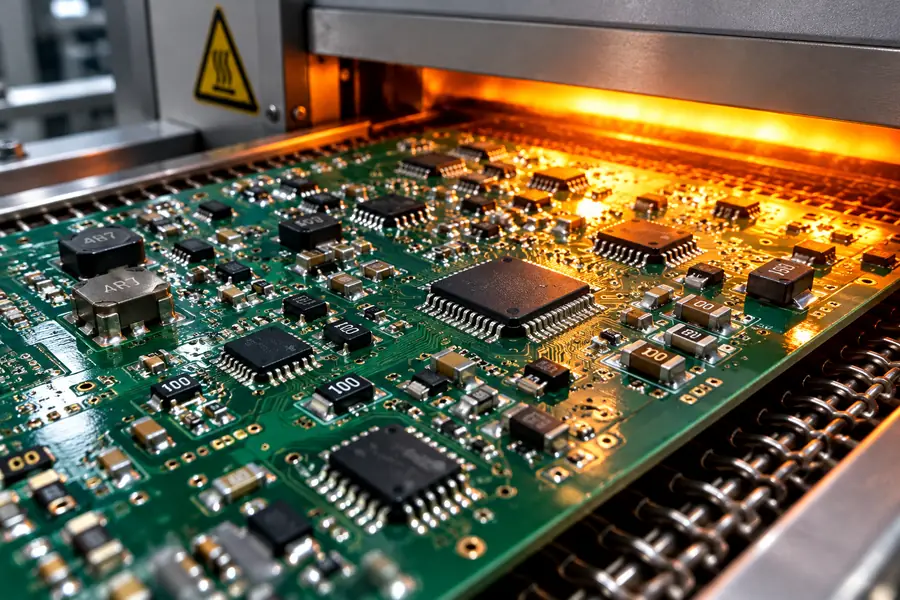
An SMT (surface-mount technology) line is a set of machines that automatically place and solder electronic components onto printed circuit boards. Choosing the right line depends mostly on your volume, your product mix and the components you need to build. This guide walks through each machine, what to check when buying, and the mistakes buyers make most often.
What machines make up an SMT line?
- Loader: feeds bare boards from a magazine onto the conveyor.
- Stencil printer: prints solder paste onto the pads through a metal stencil.
- SPI (solder paste inspection): measures paste volume, height and offset, usually in 3D.
- Pick-and-place: picks components from feeders and places them on the paste using vision alignment.
- Reflow oven: heats the board along a controlled thermal profile so the paste melts and forms joints.
- AOI (automated optical inspection): finds missing, shifted or reversed parts, bridges and other visible defects.
- Unloader: collects finished boards into a magazine.
Stencil printer: where quality starts
Industry sources repeatedly point to paste printing as the origin of a large share of SMT defects. Too little, too much or misaligned paste later becomes weak joints, bridges or tombstoned parts. Check whether you need a semi-automatic printer (prototyping, low volume) or a fully automatic one with fiducial alignment, automatic under-stencil cleaning for fine-pitch parts, and enough board size for your future products.
Pick-and-place: the biggest decision
Measure real speed, not the brochure number
Speed is quoted in CPH (components per hour), usually under ideal conditions. IPC-9850 defines a common way to measure placement performance. In real production, nozzle changes, large parts and board transfer bring effective speed well below the nominal figure, so size the machine on parts per board times daily volume against effective, not nominal, speed.
Component range
- The smallest part you need to place (for example 0402 or 0201 imperial).
- The largest and heaviest parts (connectors, power inductors, shields).
- BGA, QFN and fine-pitch parts, and a vision system accurate enough for them.
- Feeder capacity for the number of unique parts in your most complex BOM, plus room to grow.
High-mix or high-volume?
With many products in small batches, fast changeover and programming matter more than raw speed. With a few products in large volumes, pairing a high-speed chip placer with a multi-function machine for ICs is a common choice.
Reflow oven and the thermal profile
The oven moves the board through preheat, soak, reflow and cooling zones. For common lead-free pastes such as SAC305, which melt at about 217–220 °C, peak temperature is typically set around 235–250 °C with roughly 60–90 seconds above liquidus. The paste datasheet and the component limits (J-STD-020) are always the final reference. More zones give finer profile control and higher conveyor speeds; 8 zones or more is common for continuous production. Plan for three-phase power and fume extraction before the oven arrives.
Inspection: SPI and AOI
SPI catches defects before parts are placed, when they are cheap to fix. AOI checks final quality after reflow, usually against IPC-A-610 acceptance criteria. Small lines may start with post-reflow AOI only, but as volume grows SPI quickly pays for itself through lower scrap.
Infrastructure people forget
- Clean, dry compressed air.
- ESD control to ANSI/ESD S20.20 or IEC 61340-5-1.
- Temperature and humidity control, and refrigerated solder paste storage.
- Moisture-sensitive device handling (dry cabinets, baking) per J-STD-033.
- Operator and programmer training, spare parts and nozzles.
Common buying mistakes
- Choosing on brochure CPH alone.
- Ignoring feeder count and the cost of extra feeders.
- Mixing machines from several sources without checking line communication (SMEMA) and support.
- Leaving power, air and ventilation until installation day.
- No plan for after-sales service, spares and training.
Rule of thumb: design the line for the product you will build in two years, not just for today's order.
How Havin helps
Havin Electric consults on, sells and installs SMT assembly lines. We size the line around your real products and volumes, source and import the machines, and handle installation, commissioning and operator training.
Havin is the official representative of two Chinese manufacturers, Kayo and HCT, in Iran, and also works with leading Korean and Japanese brands, so we can compare options side by side for your budget. See the machines at kayosmt.ir and hct-smt.ir.